February 4, 2026 | In Air Quality, Resources, Sustainability
Breathe Easier, Learn Better
Unlock $45K for School Air Quality Upgrades
When we talk about Indoor Air Quality in schools, it’s easy to think of it as a facilities issue, something for maintenance staff to handle behind the scenes. However, the reality is much more powerful: air quality isn’t just a building issue. It’s an educational equity issue.
The air students breathe directly impacts their ability to learn, their health outcomes, and their academic success. Districts serving low-income and tribal communities are even more pronounced with these impacts.
As applications open for Cohort 2 of the NSBA/Go Green Initiative IAQ grant, let’s look at what happens when schools get serious about air quality and learn from the 10 districts already leading the way.
THE RESEARCH – IAQ AND STUDENT OUTCOME
Multiple studies have documented the connection between indoor air quality and educational outcomes:
ATTENDANCE & HEALTH
- Schools with better ventilation see 15-20% reductions in student absences
- Improved air quality reduces asthma symptoms and respiratory infections
- Students with asthma miss 60% more school ays than peers and IAQ improvements help close this gap
ACADEMIC PERFORMANCE
- Students in well-ventilated classrooms score 5-10% higher on standardized tests
- Better air quality improves cognitive function, concentration and memory
- Reduced CO2 levels correlate with better decision-making and problem-solving
COHORT 1 IN ACTION: REAL DISTRICTS, REAL PROGRESS
Our first 10 districts are already proving what’s possible:
- Boston Public Schools, MA – Working to install air-quality monitors in every classroom across 120+ schools, demonstrating how large urban districts can scale IAQ improvements. “The air our students breathe should be as thoughtfully designed as their curriculum,” said Katherine Walsh, director of planning, engineering, sustainability and environment.
- Standard School District, CA – In Bakersfield, where wildfire smoke, dust and extreme heat are frequent challenges, the district uses preventive maintenance, real-time monitoring, and HEPA filtration during smoke events to protect student health.
- Arlee Joint School District, MT – Students are collecting air quality data in environmental science classes, turning classrooms into living laboratories. “By engaging students, staff, and district leadership in monitoring, maintenance, and communication, we are building systems that support consistently healthy learning environments,” says teacher Bonnie White.
- East St. Louis School District 189, IL – After years of underinvestment, the district is channeling federal and state funds into HVAC modernization and air-quality monitoring. “We’re treating indoor air quality not just as a technical upgrade, but as a fundamental component of a healthy learning environment,” said Joseph Haskell, director of maintenance, operations, and risk management.
- Salamanca City Central School District, NY – Located on Seneca Nation Territory, the district is aligning IAQ improvements with traditional stewardship principles to make improvements that will benefit the next seven generations of indigenous students.
OTHER COHORT 1 LEADERS
- Alexandria City Public Schools, VA – Strengthening their existing IAQ Management Plan with measurable goals
- Bibb County School District, GA – Modernizing 40+ year old facilities while building on strong energy management
- Tornillo ISD, TX – Integrating IAQ into their mission of supporting the whole student
- North Daviess R-III School District, MO – Meeting national standards despite limited staffing and a single school building
THE EQUITY DIMENSION
Students in under-resourced communities often face the greatest air quality challenges:
- Older buildings with deferred maintenance
- Higher rates of asthma and respiratory conditions
- Limited resources to address these issues
- Environmental justice concerns
Improving IAQ in these schools isn’t just about buildings; it’s about educational equity. Strengthening IAQ ensures all students, regardless of their zip code or economic status, have learning environments that support their health and success.
THE HIDDEN COST OF POOR AIR QUALITY
Consider this, a student who misses 10 extra days of school per year due to respiratory issues falls behind academically. Multiply that by dozens or hundreds of students in a district. The learning loss is staggering.
Now consider the alternative: students who attend school more consistently, concentrate better, and perform at their full potential.
WHAT THE IAQ GRANT MAKES POSSIBLE
For the 10 districts selected for Cohort 2, comprehensive IAQ improvement becomes achievable:
THE RESOURCES
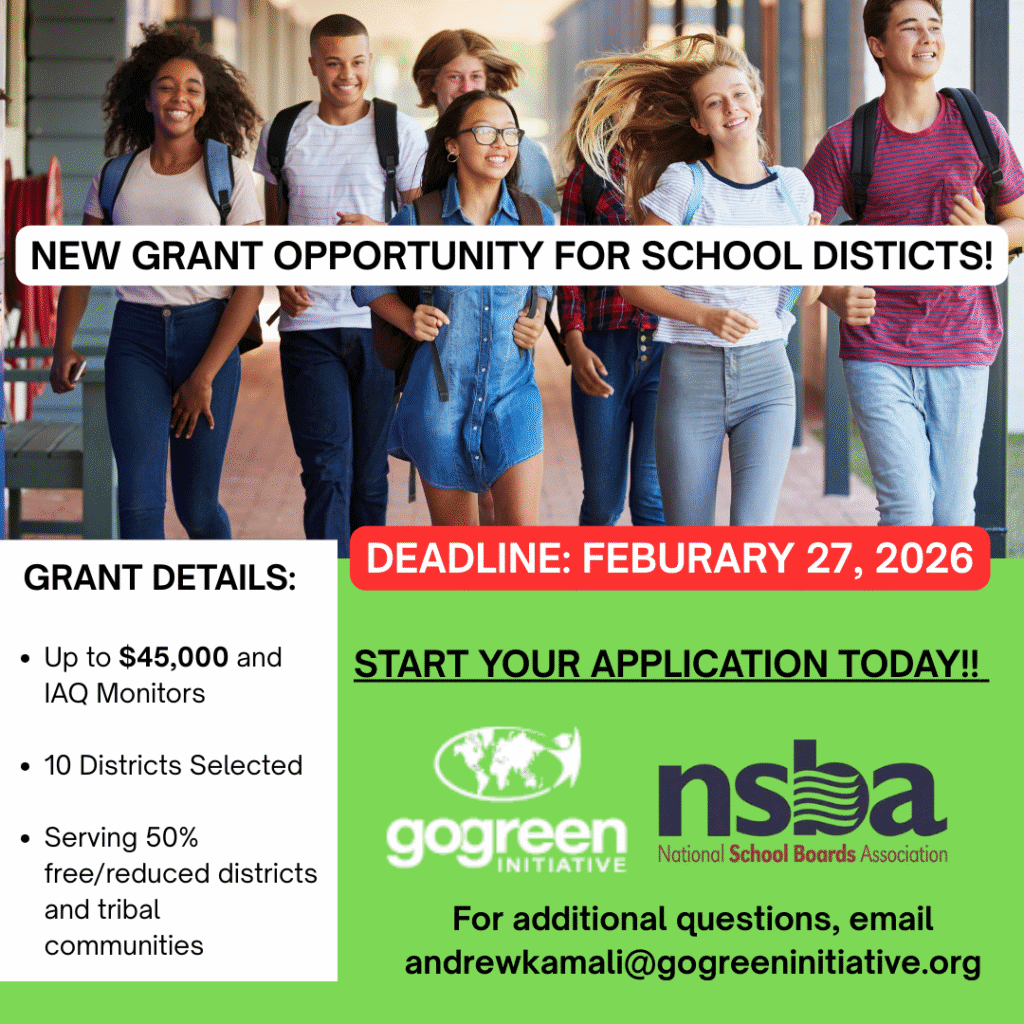
- $45,000 in funding for improvements
- Professional-grade IAQ monitoring equipment
- Expert technical assistance from EPA and Go Green Initiative staff
- Comprehensive training for district stakeholders
- Proven frameworks and implementation plans
THE PROCESS
Districts selected don’t just receive funding, they receive a partnership. EPA and Go Green Initiative staff work alongside you to:
- Conduct baseline assessments of your current IAQ status
- Develop customized improvement plans based on your specific needs
- Implement evidence-based strategies proven to work
- Train your staff to sustain improvements long-term
- Measure and document the impact on student outcomes
THE OUTCOMES
- Measurable improvements in air quality across buildings
- Data-driven decision making supported by real-time monitoring
- Sustainable IAQ management systems that outlast the grant period
- Reduced greenhouse gas emissions and energy costs
- Healthier learning environments for students and staff
- Model practices that can be shared with other districts
THE MULTIPLIER EFFECT
Districts that participate in this program don’t just improve their own schools, they become models for others. When you successfully implement IAQ improvements, you demonstrate to neighboring districts that it’s possible. You share lessons learned.
Cohort 1 is already creating this ripple effect. From Boston’s scale to North Daviess’ creative solutions for a single building, these districts are showing that improved air quality doesn’t require massive budgets.
YOUR OPPORTUNITY TO CREATE IMPACT
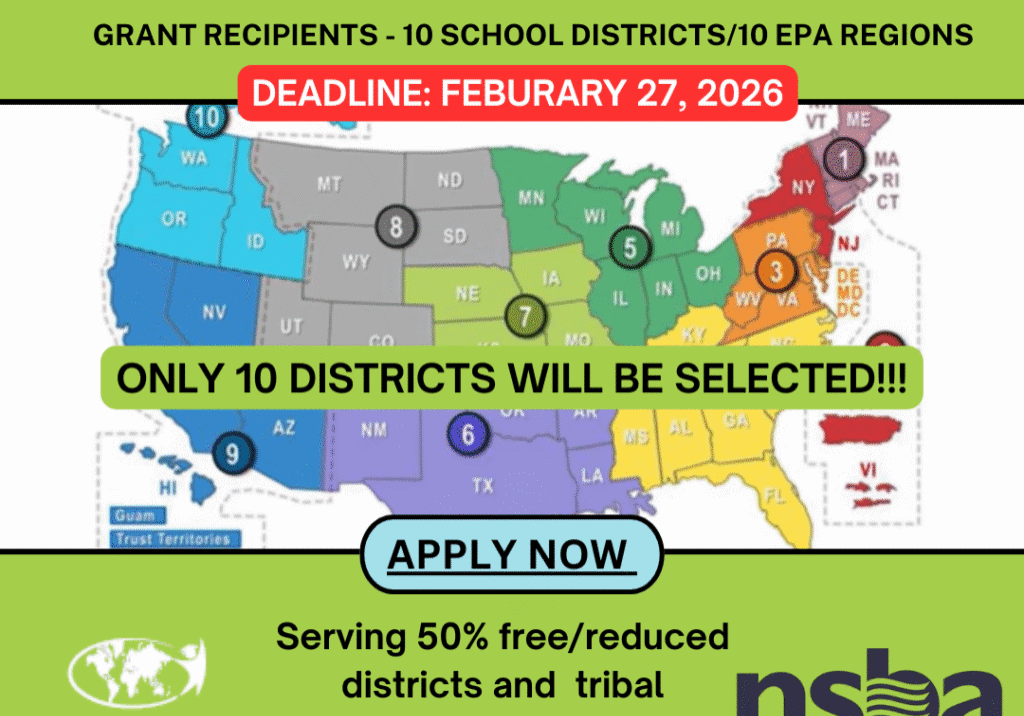
If your district serves 50% or more students qualifying for free/reduced lunch or if you serve a Tribal community, this grant is designed specifically for you.
With only 10 spots available nationwide for Cohort 2, the selection will be competitive.
THE QUESTION ISN’T WHETHER IAQ MATTERS
The research is clear. Cohort 1 is proving it works. The impact is documented. The question is, “Will your district be one of the 10 selected for Cohort 2?”
Deadline: February 27, 2026
READY TO CREATE IMPACT?
Your students deserve to learn in environments where the air they breathe supports their health and success.
This grant provides everything you need:
- The funding to make improvements
- The equipment to monitor progress
- The expertise to implement effectively
- The framework to sustain results
- The proof from Cohort 1 that it works
But first, you have to apply:
Questions? Contact Andrew Kamali at andrewkamali@gogreeninitiative.org
WHAT HAPPENS NEXT
After you apply:
- Applications are reviewed by a panel of experts
- Selection criteria prioritize need, readiness and potential impact
- The 10 selected districts are notified in spring 2026
- Onboarding begins summer 2026
- Implementation starts September 1, 2026
One year from now, those 10 districts will have:
- Healthier students missing fewer days of school
- Data showing measurable improvements in air quality
- Systems in place to sustain those improvements
- Stories of transformation to share with others
Your district could be one of them. But only if you apply.
THE BOTTOM LINE
Improving Indoor Air Quality in schools isn’t just nice to have, it’s essential for educational equity, student health and academic success.
Cohort 1 has shown that districts of all sizes from 50 students to 50,000, can achieve transformational results. This grant makes comprehensive IAQ improvement achievable for 10 more districts that need it most.
Will yours be one of them?
Deadline: February 27, 2026
Your students are counting on you.