July 1, 2026 | In Air Quality, Climate Change, Energy, Health, Recycling and Waste, Resources, Sustainability, Water
Building Healthier Schools Together
How National Partnerships Are Improving Indoor Air Quality and Sustainability

“Healthy schools aren’t built by one organization. They’re built by partnerships.”
America’s schools face an urgent public health challenge hiding in plain sight.
According to the U.S. Environmental Protection Agency, indoor air can be two to five times more polluted than outdoor air — and children spend up to seven hours each school day breathing it. Poor indoor air quality (IAQ) has been linked to increased asthma symptoms, higher rates of absenteeism, and reduced cognitive performance. For the roughly one in 13 school-age children who has asthma, the classroom environment isn’t just a comfort issue. It’s a health issue — and a learning issue.
These challenges fall hardest on the school communities least equipped to address them: districts where the majority of students qualify for free or reduced-price lunch, rural schools with aging infrastructure and limited budgets, and Tribal schools that have historically been underserved by national programs.
The Go Green Initiative was built to change that. With an $8 million EPA grant supporting our national indoor air quality program, we are working to bring evidence-based IAQ and sustainability solutions directly to the districts that need them most. But no organization — including ours — can do this work alone.
That’s why partnerships matter.
Why No Single Organization Can Solve This
The challenges school districts face are deeply interconnected:
- Poor IAQ drives up absenteeism — which affects academic achievement
- Aging HVAC systems increase energy costs — which strain operating budgets
- Constrained budgets limit resources for classrooms, teachers, and facilities upgrades
- Facility performance affects teacher retention, student comfort, and long-term community resilience
Because these challenges don’t exist in isolation, neither can the solutions. Improving classroom ventilation, for example, isn’t simply a facilities issue. It requires informed governance, health expertise, technical guidance, funding strategy, staff training, and ongoing evaluation. Reducing greenhouse gas emissions isn’t just an environmental initiative — it can lower utility bills, improve building performance, and free resources for educational priorities.
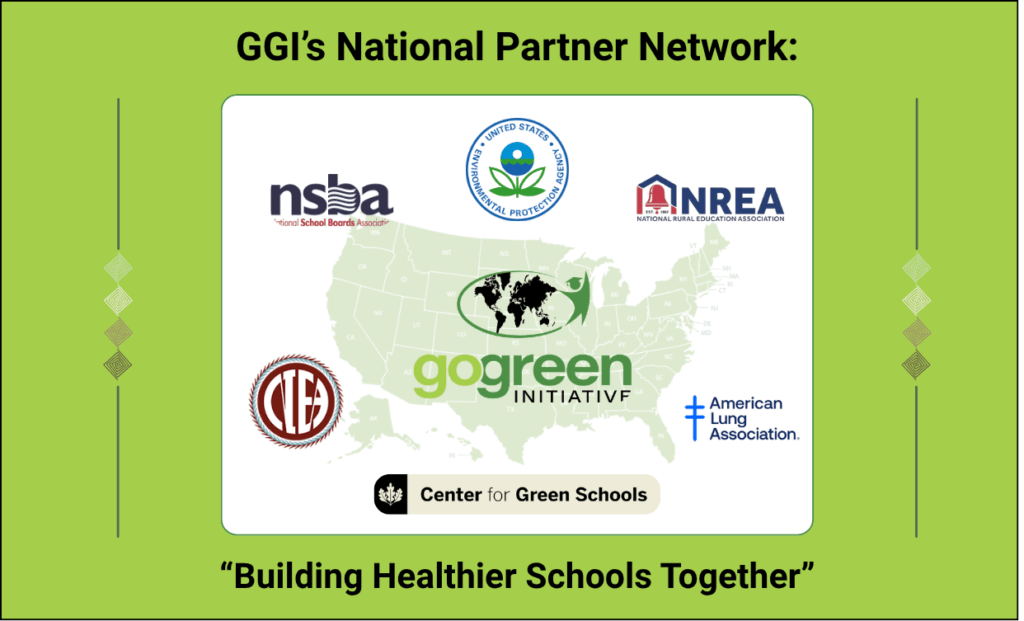
Lasting progress requires educators, facilities professionals, public health experts, environmental scientists, school board members, and community leaders working together. That’s exactly what the Go Green Initiative’s national partner network provides.
Partner Network by the Numbers
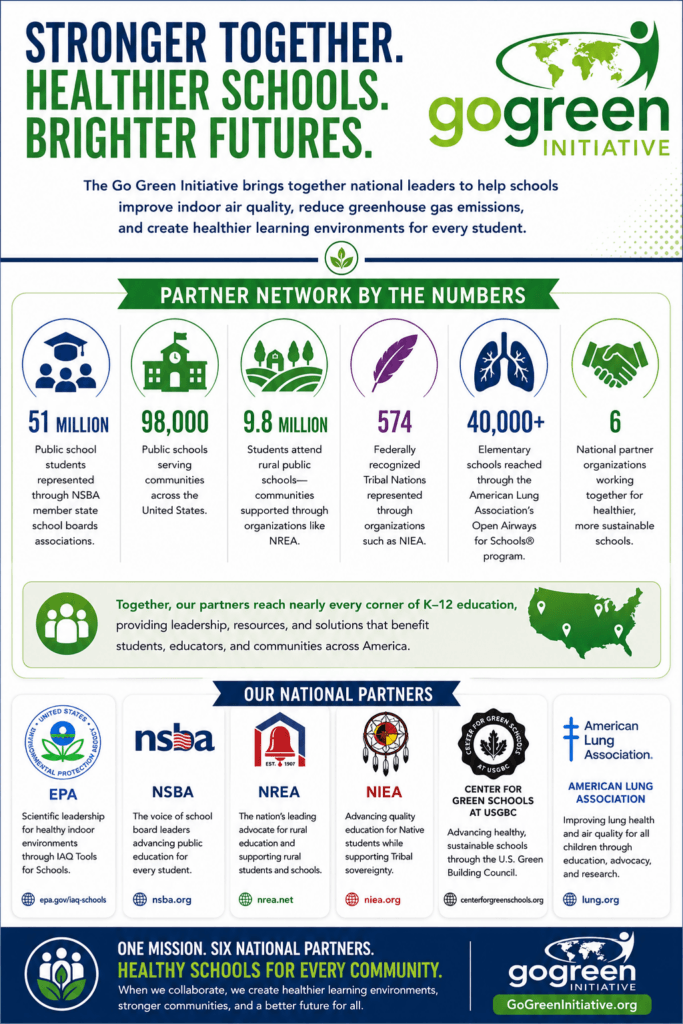
The Go Green Initiative’s national partners help extend evidence-based indoor air quality and sustainability solutions to school leaders across the United States. Together, these organizations help bring trusted leadership, practical resources, and evidence-based solutions to school communities across America.
Meet Our National Partners
Each organization in our network brings distinct expertise. Together, they create a support system that helps school districts move from identifying a problem to implementing solutions.
Scientific Leadership: U.S. Environmental Protection Agency (EPA)
The Go Green Initiative’s IAQ program is built on the EPA’s nationally recognized Indoor Air Quality Tools for Schools framework. Through EPA-supported guidance, technical resources, and the grant funding powering our work, school districts gain practical strategies for improving air quality, reducing energy waste, and creating healthier buildings.
Learn more: EPA.gov/IAQ-Schools
School Governance: National School Boards Association (NSBA)
School boards make the decisions that shape district priorities — including how buildings are maintained, where budgets are allocated, and what health and sustainability commitments get made. Through its member state associations, NSBA supports locally elected school board members serving approximately 51 million public school students nationwide.
Our partnership with NSBA helps connect board members with evidence-based resources that support informed decision-making on IAQ, sustainability, and long-term facilities planning.
Learn more: NSBA.org
Rural Education: National Rural Education Association (NREA)
Nearly one in five public school students attends a rural school — and rural districts often carry some of the heaviest burdens: aging facilities, geographic isolation, limited staffing, and constrained budgets. The National Rural Education Association ensures rural educators have a strong national voice while sharing solutions developed specifically for their communities.
Together, NREA and GGI help rural school leaders access practical, affordable strategies for improving school environments without placing additional strain on already stretched resources.
Learn more: NREA.net
Tribal Education: National Indian Education Association (NIEA)
Every Tribal community carries its own history, culture, and educational priorities. The National Indian Education Association advances educational excellence for Native students while supporting Tribal governments, educators, and communities in making decisions that reflect their values and needs.
Through this partnership, GGI works to ensure that IAQ and sustainability initiatives are designed to be responsive to Tribal schools — not imposed on them — while respecting local leadership and community knowledge.
Learn more: NIEA.org

Healthy School Buildings: Center for Green Schools
Healthy buildings support healthy learning. The Center for Green Schools — part of the U.S. Green Building Council — is one of the nation’s leading organizations focused on high-performing learning environments. Its work spans research, professional development, technical assistance, and collaborative initiatives that help districts improve building performance while reducing operating costs.
Together, the Center for Green Schools and GGI help districts understand that healthier schools and more sustainable schools are often one and the same.
Learn more: CenterForGreenSchools.org
Student Health: American Lung Association
Asthma is one of the leading causes of school absenteeism among children. For more than 120 years, the American Lung Association has been one of the nation’s most trusted voices on respiratory health. Its Open Airways for Schools® and Asthma-Friendly Schools Initiative programs give educators practical tools to reduce asthma-related absences and improve indoor air management — reaching more than 40,000 elementary schools nationwide.
This partnership reinforces a core truth: improving indoor air quality isn’t simply a facilities objective. It’s an investment in student health, staff well-being, and educational outcomes.
Learn more: Lung.org

What This Means for School Districts
For school leaders, a partner network translates into something very practical: access to the right expertise at the right time.
A school board member may first learn about IAQ through NSBA. A superintendent may find implementation strategies through GGI’s IAQ resources. A facilities director may connect with building experts through the Center for Green Schools. A school nurse may access asthma management tools through the American Lung Association. That’s not four separate conversations — that’s a coordinated system working in your district’s interest.
When those organizations work together, districts gain something more valuable than individual resources. They gain a network that helps them:
- Develop and sustain effective IAQ management programs
- Reduce greenhouse gas emissions through smarter facility operations
- Improve energy efficiency and lower utility costs
- Create healthier learning environments for students and staff
- Access proven professional development and peer learning opportunities
- Build long-term resilience through sustainable practices
Most importantly, collaboration helps districts move from asking “Where do we even begin?” to implementing solutions that make a measurable difference for students.

“When expertise is shared, every school district benefits.”
Building a Healthier Future Together
Across the country, school board members, superintendents, teachers, facilities professionals, school nurses, Tribal leaders, public health experts, and community partners are working toward the same vision: schools where every student can thrive because they’re learning in an environment that supports their health.
The Go Green Initiative is proud to help connect those leaders and bring that vision closer to reality. By working alongside our national partners, we are expanding access to evidence-based solutions — and ensuring that the districts with the greatest need are not the last ones served.
Every child deserves a healthy place to learn. We’re building the network to make it possible.
Ready to take action?
FOR SCHOOL DISTRICTS: Whether you’re just starting to assess your IAQ program or looking to take the next step, GGI’s resources are designed to meet you where you are. Explore our IAQ resources:
FOR ORGANIZATIONS: Creating healthier schools is a shared responsibility. GGI welcomes partnership opportunities with educational associations, Tribal organizations, government agencies, nonprofits, healthcare leaders, foundations, and businesses committed to improving student health and school sustainability. Learn more about partnering with GGI: