April 2, 2026 | In Air Quality, Resources
Why Every School District Should Start with an IAQ Needs Assessment
A practical first step toward healthier classrooms, lower energy costs, and smarter policy decisions
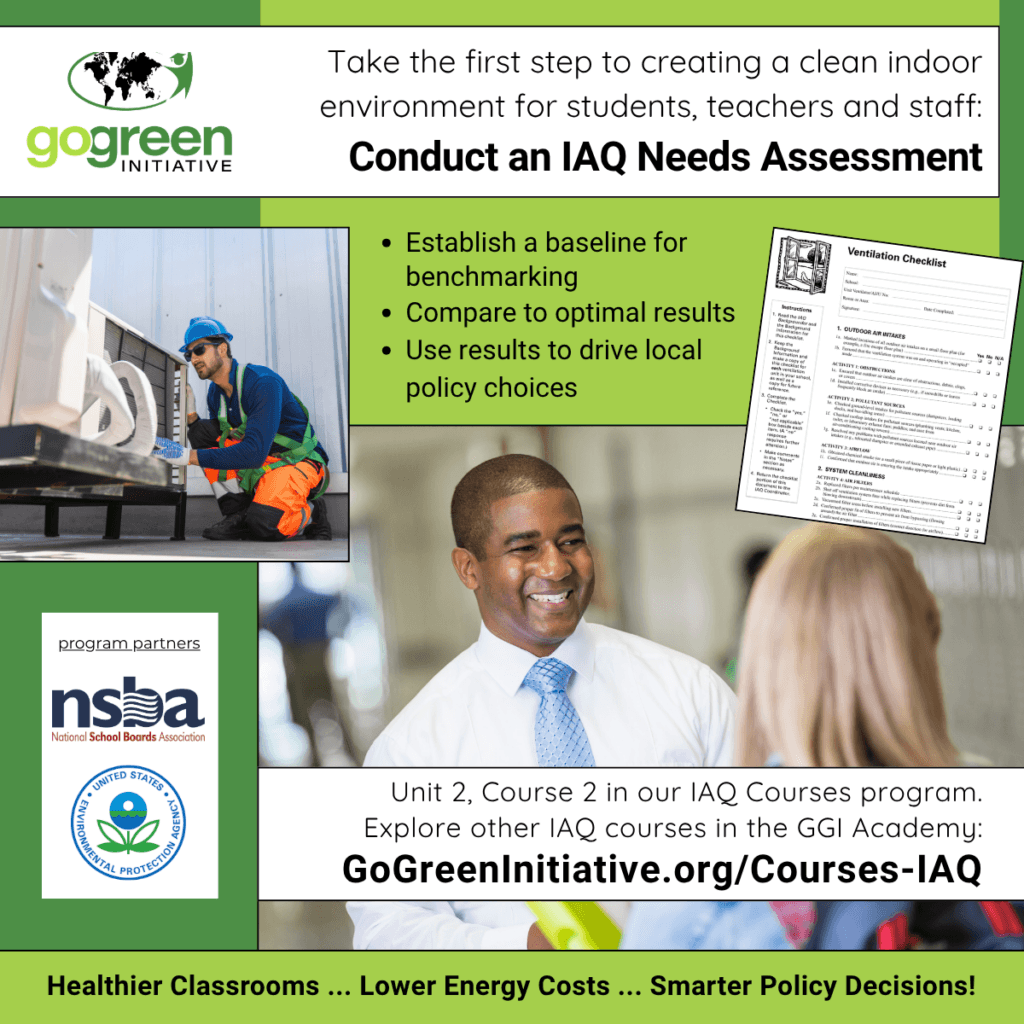
Across the United States, school districts are facing a convergence of challenges: aging facilities, rising energy costs, declining enrollment, and increasing pressure to improve student outcomes. Yet one of the most impactful—and often overlooked—levers for improving both health and performance is indoor air quality (IAQ).
According to the U.S. Environmental Protection Agency (EPA), Americans spend approximately 90% of their time indoors, where pollutant levels can be 2 to 5 times higher than outdoor levels. In schools, where children are especially vulnerable to environmental hazards, poor IAQ has been linked to increased absenteeism, asthma exacerbation, reduced concentration, and lower academic performance.
For school leaders seeking a practical, data-driven way to address these issues, the answer is clear: start with an IAQ Needs Assessment.
What Is an IAQ Needs Assessment—and Why Does It Matter?
An IAQ Needs Assessment is a systematic process used to evaluate the current conditions of a school’s indoor environment. It identifies existing risks, gaps in ventilation and filtration, maintenance issues, and opportunities for improvement.
Rather than guessing where problems exist—or investing in costly upgrades without a clear strategy—an assessment provides a baseline understanding of:
- Ventilation performance (HVAC systems, outdoor air exchange)
- Filtration effectiveness (MERV ratings, maintenance schedules)
- Indoor pollutants (CO₂, particulate matter, VOCs, radon)
- Moisture and mold risks
- Occupant comfort (temperature, humidity, airflow)
- Operational practices (cleaning protocols, maintenance routines)
This baseline is essential because you cannot manage what you do not measure. The EPA’s Indoor Air Quality Tools for Schools program emphasizes that schools with proactive IAQ management programs see reduced exposure to airborne contaminants and improved health outcomes for students and staff.

The Hidden Cost of Poor IAQ in Schools
Poor IAQ is not just a facilities issue—it is a financial, academic, and public health issue.
Health Impacts
- Asthma is one of the leading causes of school absenteeism. The CDC reports that more than 4 million children in the U.S. have asthma, and indoor air pollutants are a major trigger.
- Exposure to pollutants like mold, dust, and VOCs can lead to headaches, fatigue, and respiratory issues for both students and staff.
Academic Performance
- Studies have shown that improved ventilation can increase student performance by up to 8–14% in reading and math scores (https://heschongmahone.com/reports/daylighting/schooldaylighting/).
- Elevated CO₂ levels—common in poorly ventilated classrooms—are associated with reduced cognitive function and decision-making ability.
Financial Strain
- Reactive maintenance is significantly more expensive than proactive management due to emergency repairs and system failures (https://www.energy.gov/eere/buildings/articles/operations-maintenance-best-practices-guide).
- Energy inefficiency often goes hand-in-hand with poor IAQ—meaning districts may be overpaying for energy while still delivering unhealthy environments.
An IAQ Needs Assessment helps districts quantify these hidden costs and prioritize investments that deliver the greatest return.

From Assessment to Action: Building an Energy-Efficient IAQ Management Plan
Conducting an IAQ Needs Assessment is not the end goal — it is the foundation for a broader strategy.
Once a district understands its current conditions, it can begin building an Energy-Efficient IAQ Management Plan that aligns health outcomes with operational efficiency.
This integrated approach is critical. Historically, energy efficiency and IAQ have been treated as competing priorities. However, modern best practices—and EPA guidance—show that they can and should work together (https://www.epa.gov/iaq-schools/protecting-indoor-air-quality-during-energy-efficiency-retrofits).
An effective IAQ Management Plan includes:
- Data-driven decision-making based on assessment results
- Energy benchmarking using tools like ENERGY STAR Portfolio Manager
- Targeted upgrades (ventilation improvements, filtration enhancements, controls)
- Preventive maintenance schedules
- Staff training and accountability systems
- Ongoing monitoring and continuous improvement
By starting with an assessment, districts can avoid one-size-fits-all solutions and instead develop a plan tailored to their specific buildings, budgets, and community needs.

Prioritizing What Matters Most
One of the greatest benefits of an IAQ Needs Assessment is the ability to prioritize.
Most districts do not have unlimited funding. The challenge is not identifying whether improvements are needed—it is determining which actions will have the greatest impact.
An assessment allows districts to:
- Identify high-risk buildings or classrooms
- Address low-cost, high-impact fixes first (e.g., filter upgrades, maintenance adjustments)
- Plan for long-term capital improvements
- Align IAQ improvements with energy savings opportunities
- Support grant applications and funding requests with credible data
This prioritization is especially important as districts navigate the expiration of ESSER funding and increased scrutiny on budget decisions.
From Operations to Policy: Turning Insights into Lasting Change
An often-overlooked outcome of an IAQ Needs Assessment is its role in shaping district policy.
Assessment data provides the evidence needed to create or update IAQ and greenhouse gas (GHG) policies at the school board level. These policies institutionalize best practices, ensuring that improvements are sustained over time—not lost due to staff turnover or shifting priorities.
Strong IAQ/GHG policies can:
- Establish minimum ventilation and filtration standards
- Require routine inspections and reporting
- Integrate IAQ into capital planning and budgeting
- Align with state and federal guidelines
- Demonstrate a district’s commitment to student and staff health
For districts unsure where to begin, the Go Green Initiative’s national IAQ Policy Database offers ready-to-use templates and examples from every state across the country:
Why This Matters Now
The urgency around IAQ has never been greater.
- Schools are still addressing the long-term impacts of the COVID-19 pandemic.
- Wildfires and extreme weather events are increasing exposure to outdoor pollutants.
- Energy costs are rising, putting additional pressure on already strained budgets.
- Communities are demanding healthier, safer learning environments.
At the same time, there is unprecedented access to tools, training, and funding opportunities to support IAQ improvements.
Districts that take a proactive approach — starting with an IAQ Needs Assessment — are better positioned to:
- Improve student health and attendance
- Enhance academic performance
- Reduce operational costs
- Strengthen community trust
- Compete for grants and recognition programs

A Practical First Step for Every District
The path to healthier, more efficient schools does not require a massive upfront investment. It starts with a clear understanding of where you are today.
Conducting an IAQ Needs Assessment is a practical, achievable first step that delivers immediate value:
- It replaces guesswork with data
- It aligns stakeholders around shared priorities
- It creates a roadmap for improvement
- It lays the groundwork for long-term policy and funding success
For school district leaders, facilities managers, and school board members, the message is simple:
If you want to improve indoor air quality, reduce energy costs, and create better learning environments — start with an assessment.
Take the Next Step
The Go Green Initiative offers free, expert-led resources to support every stage of this process:
These tools are designed specifically for K–12 schools—helping districts turn intention into action, and data into meaningful change.
Conclusion
Indoor air quality is no longer a secondary concern—it is central to student success, staff well-being, and district sustainability.
An IAQ Needs Assessment provides the clarity and direction needed to make smart, impactful decisions. It connects health, energy efficiency, and policy into a unified strategy that benefits the entire school community.
In a time of tight budgets and high expectations, it is one of the most powerful steps a district can take.
Start with the data. Build with purpose. Lead with impact.