May 18, 2026 | In Air Quality, Energy
2027 Magna Awards – Applications Are Now Open …
… and the playing field just got more level!
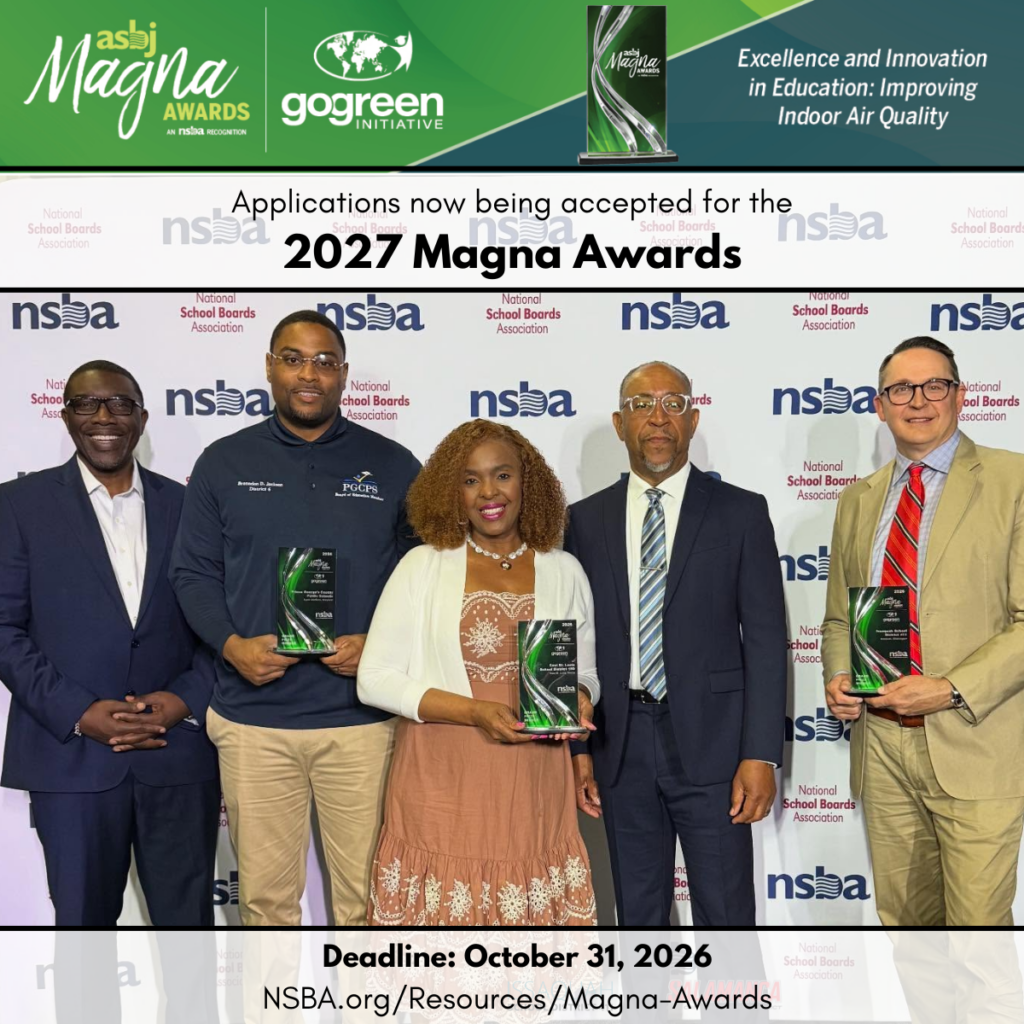
If your district has been watching the Magna Awards from the sidelines, this is your year to get in the game.
The 2027 Magna Awards, co-sponsored by the National School Boards Association (NSBA) and the Go Green Initiative (GGI), are now accepting applications — and for the first time in the program’s 31-year history, winners will be recognized by community type rather than enrollment size. That shift to Urban, Suburban, and Rural categories changes who can win, and it changes the calculus for every district that has ever thought, “We’re probably not competitive.”
You may be more competitive than you think.
What Changed — and Why It Matters
In previous years, the Magna Awards recognized districts within three enrollment-size tiers: under 5,000 students, 5,000–20,000, and over 20,000. On paper, that sounds fair. In practice, a rural district in western New York is doing something fundamentally different from a large suburban district outside Washington, D.C. — and the challenges they face, the resources available to them, and the IAQ solutions that make sense for their communities are rarely comparable.
The new Urban, Suburban, and Rural categories acknowledge that reality. By grouping districts that share a community context rather than just a headcount, the 2027 program creates a more meaningful competition — one where a small rural district isn’t measured against a district with ten times the facilities staff and budget.
To put the change in concrete terms: look at the five districts honored in the 2026 Magna Awards. Under the old enrollment-based structure, they competed as small, mid-size, and large. Under the 2027 framework, they would most likely be grouped this way:
| District | 2026 Category | Likely 2027 Category |
|---|---|---|
| East St. Louis SD 189 — IL | Under 5,000 | Urban |
| Issaquah SD 411 — WA | 5,000–20,000 | Suburban |
| Prince George’s County Public Schools — MD | Over 20,000 | Suburban |
| Salamanca City Central SD — NY | Under 5,000 | Rural |
| Boston Public Schools — MA | Over 20,000 | Urban |
(Note: Final category definitions for the 2027 program will be determined by NSBA. Classifications above reflect reasonable geographic projections based on community type.)
That’s three distinct community contexts producing five remarkable IAQ programs. The new structure ensures that a district like Salamanca — small, rural, and serving a significant Indigenous population — can compete for recognition on terms that honor what it actually accomplished, not simply how large it is.
What the 2026 Winners Did — and What You Can Learn From It

We covered the 2026 winners when they were announced in March, but as you look ahead to your own application, it’s worth focusing on the specific actions that earned each district recognition — because the Magna Awards reward documented, replicable programs. Here’s what set each winner apart:
East St. Louis SD 189 (Illinois) — Grand Prize The Board of Education approved a carbon-free schools initiative and a five-year carbon footprint reduction and energy savings plan — a roadmap that ties fiscal responsibility directly to environmental health. In a district where nearly two-thirds of students are economically disadvantaged, that alignment of budget planning with environmental stewardship is as strategic as it is meaningful.
Issaquah SD 411 (Washington) — Grand Prize The school board adopted a formal IAQ policy aligned with EPA standards, with explicit objectives: reduce indoor air pollutants through preventative measures, maintain ventilation equipment, and provide timely progress reports to all stakeholders. As Director of Facility Services Julius Carter described it, clean air in Issaquah is “the result of careful planning, consistent maintenance and a daily focus on continuous improvement.” Policy first. Implementation follows.
Prince George’s County Public Schools (Maryland) — Grand Prize PGCPS developed a comprehensive IAQ plan through its dedicated Environmental Office, built on EPA and GGI guidelines. For a district serving more than 132,000 students — over 60% of whom qualify for free or reduced-price lunch — this plan isn’t a corporate sustainability initiative. It’s a health equity commitment backed by institutional infrastructure.
Salamanca City Central SD (New York) — Silver Award Salamanca aligned its IAQ improvements with energy-efficiency initiatives through a framework rooted in traditional Indigenous stewardship — the principle of planning for the next seven generations. That lens doesn’t just inform the district’s sustainability goals; it reflects its responsibility to the community it serves. It’s a model for how IAQ work can be culturally grounded as well as technically sound.
Boston Public Schools (Massachusetts) — Silver Award BPS installed IAQ sensors in every classroom, nurse’s office, and main office — plus rooftop sensors for outdoor baseline measurements. What began as a COVID-era response became a permanent, data-driven approach to air quality management across one of the country’s most complex urban school systems.
Five very different districts. Five very different approaches. One thing in common: they all documented their work, engaged their school boards, and built IAQ programs designed to last.
How Winners Are Chosen: The Point System Explained
The Magna Awards aren’t a nomination contest where a panel picks a favorite. They’re a structured, competitive process judged by members of the NSBA Board of Directors Awards Committee and senior staff from the Go Green Initiative. Judges look for three things: a properly developed IAQ plan, demonstrated district leader support, and cumulative points earned throughout the year. That last element — the point system — is what makes this competition uniquely actionable, because districts can build their scores steadily from the moment they apply.
For the 2027 program, there are up to 500 points available across five areas:
1. Submit a new IAQ Management Plan (up to 100 points) Your plan must be written in accordance with EPA guidance for a Model IAQ Plan and cover all required components: mission statement, IAQ coordinator role, background and findings, policies and procedures, staff responsibilities, regulatory requirements, emergency response, and prevention steps. Free training is available at gogreeninitiative.org/courses-iaq.
2. Document GHG emissions for 12 months (up to 50 points) Points scale with the percentage of your district’s schools covered — from 10 points for 20% of schools up to 50 points for 100%. Documentation is done through ENERGY STAR Portfolio Manager. Free training at gogreeninitiative.org/courses-iaq.
3. Attend in-person training at NSBA convenings (up to 100 points) The 2026 CUBE conference included a breakout session with GGI CEO Jill Buck worth 100 points. Watch for similar opportunities throughout the year.
4. Complete 10 monthly IAQ webinars (up to 120 points, 12 points each) GGI offers monthly webinars on indoor air quality and GHG emissions topics. Choose any 10 from the schedule at gogreeninitiative.org/webinars-iaq. Participants receive a Certificate of Completion.
5. Complete online training courses (up to 130 points) Courses cover IAQ Management Plan development and GHG documentation using ENERGY STAR Portfolio Manager. Find the full catalog at gogreeninitiative.org/courses-iaq.
One strategic note: districts are strongly encouraged to have representatives from multiple stakeholder groups complete training — school board members, assistant superintendents, facilities managers, health officers, business officers, head custodians, and parent leaders. Broader institutional participation strengthens both your point total and your application narrative.
A few other details worth knowing:
- Eligibility: NSBA Member State Association districts and all CUBE and district members are eligible. Unsure of your status? Contact memberservices@nsba.org.
- Multiple submissions: Each email address may submit one application, but multiple team members from the same district can each submit using their own email address.
- Backup materials: Photos, videos, documents, and PDFs can be uploaded with your application and will be reviewed by judges. Strong documentation of your IAQ work — before and after comparisons, policy documents, monitoring data — can meaningfully strengthen your submission.
- Judging timeline: Judging typically takes place in late November or early December. Winners are notified in late January or early February 2027. Districts are asked not to announce the award publicly until March, when NSBA makes an official announcement and ASBJ publishes the full list of honorees.

Start Building Your Application Now
The districts that win the Magna Awards don’t typically sprint to the finish line in October. They build steadily — attending webinars, completing courses, developing their IAQ plans — throughout the year. The point system is designed to reward that sustained effort.
If your district is new to IAQ planning, start with the free IAQ training resources at gogreeninitiative.org/IAQ. If you’re already doing this work, the 2027 Magna Awards are your opportunity to document it, be recognized for it, and inspire other districts to follow your lead.
Every district that pursues this process — whether or not it wins — comes out with stronger systems, better documentation, and a clearer picture of what healthy schools look like.
The application deadline is October 31, 2026. Grand Prize winners will present their programs at a special Education Session at NSBA’s Annual Conference in Washington, D.C., April 2–4, 2027. All winning districts will be featured in the April 2027 issue of American School Board Journal.
Apply now at nsba.org/resources/magna-awards.
Questions? Contact NSBA Member Services at memberservices@nsba.org or explore GGI’s IAQ hub at gogreeninitiative.org/IAQ. For the full FAQ, visit nsba.org/resources/magna-awards/magna-awards-winners/magna-awards-faq.

Go Green Initiative is the co-sponsor of the NSBA Magna Awards and provides free IAQ training and resources for school districts at gogreeninitiative.org/IAQ. GGI’s work is supported in part by an $8 million EPA grant focused on improving indoor air quality in K–12 schools with an equity lens.