June 2, 2026 | In Air Quality, Climate Change, Energy, Resources
Why Baseline and Annual Assessments Are the Engine of Every Successful IAQ Program
How to move from good intentions to measurable results — and build the documentation that wins grants, supports policy, and earns national recognition
Across the country, school districts are making meaningful investments in indoor air quality — adopting board policies, completing needs assessments, and developing IAQ management plans. That momentum is real, and it matters.
But there is a question every district eventually faces: How do we know if any of this is working?
The answer is assessments. Specifically, baseline and annual assessments: the systematic, repeatable process of measuring what your indoor environment actually looks like, documenting it, and using that data to drive continuous improvement.
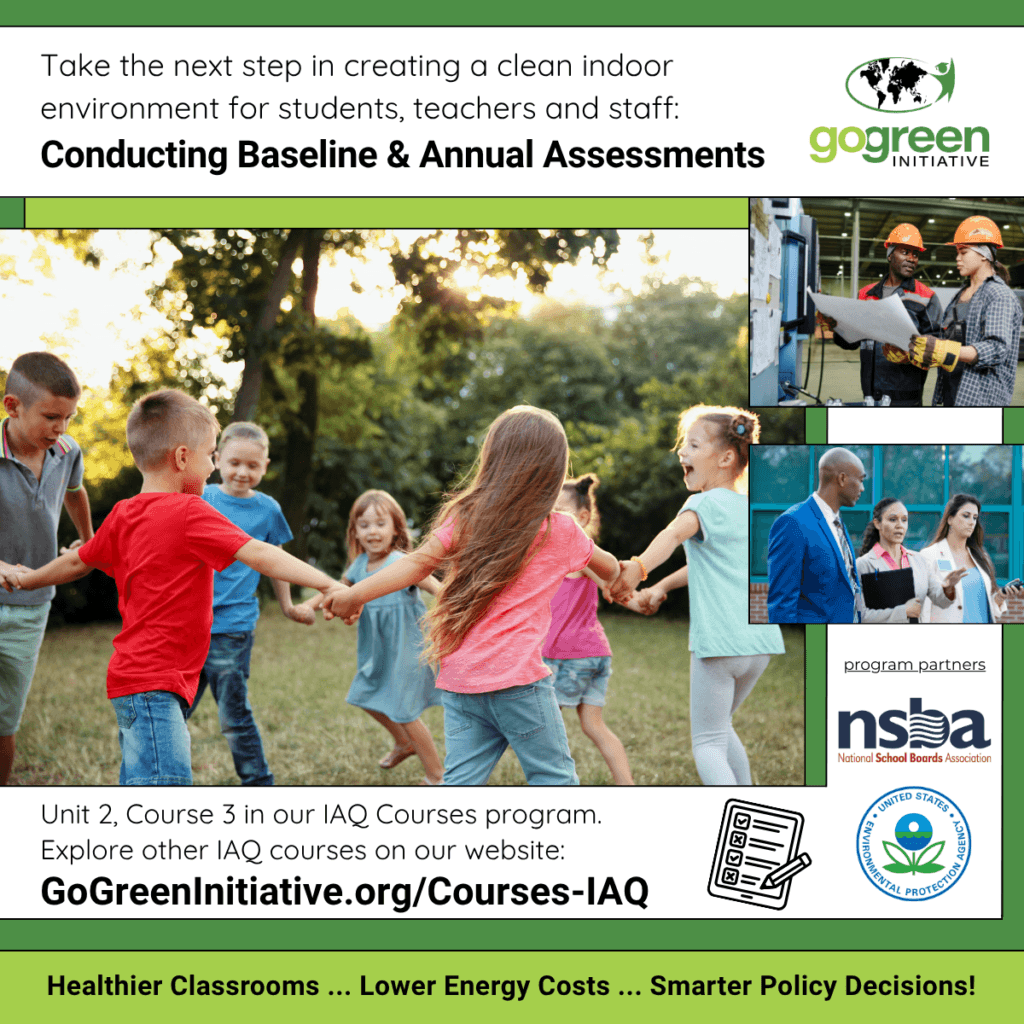
The Go Green Initiative’s newest free course, Conducting Baseline and Annual Assessments (Unit 2, Course 3), is designed to help school districts answer that question with confidence. It is part of GGI’s growing library of free, on-demand IAQ training built for K–12 school leaders, facilities staff, and IAQ coordinators who are ready to move from intention to action.

What Is a Baseline Assessment, and Why Does It Come First?
A baseline assessment is exactly what it sounds like: a comprehensive snapshot of your school buildings’ indoor air quality conditions at a defined point in time.
Before you can set goals, allocate resources, or measure progress, you need to know where you are starting. The EPA’s Indoor Air Quality Tools for Schools program is explicit on this point: Effective IAQ management begins with understanding current conditions, not assumptions about them.
Without a baseline, districts are managing by instinct. With one, they are managing by data, a distinction that matters for every decision that follows.
A thorough baseline assessment captures:
- Ventilation performance: Is outdoor air actually getting in? Are HVAC systems operating as designed?
- Filtration effectiveness: What MERV ratings are in use? When were filters last changed?
- Indoor air pollutants: CO₂ levels, particulate matter, VOCs, radon, and other contaminants
- Moisture and mold indicators: Visible signs, humidity levels, and moisture-prone areas
- Energy consumption and GHG emissions: Building-level data that connects IAQ to sustainability goals
- Occupant comfort: Temperature, humidity, and airflow from the perspective of the people in the building
- Operational practices: Cleaning protocols, maintenance routines, and staff awareness
This is the foundation. Everything else in your IAQ program — your goals, your priorities, your management plan — is built on what the baseline reveals.

What’s Inside the Course: Six Lessons, One Complete Framework
The Conducting Baseline and Annual Assessments course is structured to take IAQ coordinators and facilities teams through the entire assessment process, from planning through analysis. Here is what each lesson covers:
Lesson 1: Baseline Assessments — Purpose, Process & People
Who needs to be involved? What are you trying to learn? This lesson establishes the why and the who before the how — helping districts assemble the right team and enter the process with clear objectives.
Lesson 2: IAQ Building Walkthrough Assessment
The walkthrough is the heart of any building-level assessment. This lesson provides a structured approach to evaluating physical conditions across your facilities — identifying problems that data alone might miss and capturing observations that inform everything downstream.
Lesson 3: IAQ Monitors
Technology can do a significant portion of the measurement work — if you know how to use it. This lesson covers the types of IAQ monitoring equipment available to schools, how to deploy them effectively, and how to interpret what they measure.
Lesson 4: Energy Consumption and GHG Emissions
IAQ and energy efficiency are not competing priorities — they are deeply connected. This lesson shows how to capture energy consumption data as part of your baseline assessment, linking indoor air quality management to greenhouse gas reduction goals and laying the groundwork for ENERGY STAR® Portfolio Manager® documentation.
Lesson 5: Analysis and Reflection
Data without analysis is just numbers. This lesson guides teams through the process of reviewing what the assessment found, identifying patterns and priorities, and translating findings into actionable next steps.
Lesson 6 (IAQ Coordinators Only): Training and Norming for Building Assessment Leads
For districts deploying assessments across multiple sites, consistency is essential. This lesson is designed specifically for IAQ coordinators who are responsible for training and calibrating the staff conducting building-level assessments — ensuring that data collected at different schools is comparable and reliable.

Annual Assessments: Turning a Snapshot Into a Trend Line
- A baseline assessment answers the question: Where are we now?
- Annual assessments answer a more powerful question: Are we getting better?
This is where IAQ management becomes a genuine program rather than a one-time project. By repeating the assessment process on a consistent schedule, districts can:
- Detect emerging problems early … before a maintenance issue becomes a health crisis
- Measure the impact of improvements … and demonstrate return on investment to school boards and communities
- Maintain accountability … ensuring that IAQ commitments made in policy are reflected in practice
- Generate the documentation that supports grant applications, regulatory compliance, and recognition programs
The EPA has long emphasized that proactive IAQ management, including regular monitoring and documentatio, reduces exposure to indoor air pollutants and improves health outcomes for students and staff. Annual assessments are how that commitment becomes verifiable.
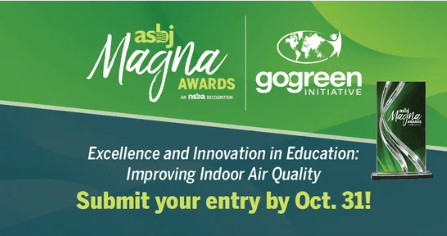
For districts pursuing the 2027 Magna Awards (co-sponsored by NSBA and the Go Green Initiative), this documentation is especially important. The Magna Awards reward districts with structured, evidence-based IAQ programs, and assessment data is central to a competitive application. The application deadline is October 31, 2026. Learn more and apply at NSBA.org/resources/Magna-Awards.
The Link Between Assessment Data and Magna Award Applications
If your district is building toward a 2027 Magna Award application, baseline and annual assessment data is not a nice-to-have. It is foundational.
The Magna Awards point system rewards districts that develop IAQ management plans written in accordance with EPA guidance, document GHG emissions, and demonstrate sustained institutional commitment to IAQ. Each of those elements requires real data from real assessments.
Consider what strong assessment documentation enables your application to show:
- Before-and-after comparisons that demonstrate measurable improvement
- Ventilation and filtration records that support claims of preventive maintenance
- Energy and GHG data aligned with ENERGY STAR® Portfolio Manager® documentation
- A narrative of continuous improvement backed by annual data, not anecdote
The 2026 Magna Award winners — including East St. Louis SD 189, Issaquah SD 411, Prince George’s County Public Schools, Salamanca City Central SD, and Boston Public Schools — all shared one characteristic: they documented their work. Assessment data is how documentation begins.
Why Equity Demands Better Data
For districts serving high-need communities (those where the majority of students qualify for free or reduced-price lunch) or those serving Native American populations, accurate IAQ assessments are not just a program requirement. They are an equity imperative.
Research consistently shows that schools in lower-income communities are more likely to have older HVAC systems, deferred maintenance backlogs, and higher rates of environmental health hazards. The children most likely to be harmed by poor indoor air quality are also the children least likely to have access to well-resourced schools.
Baseline assessments give these districts the data they need to make the case — to their boards, to state agencies, and to federal grant funders — that investment is both justified and urgent. You cannot advocate for resources you cannot document the need for.
GGI’s IAQ work is supported in part by an $8 million EPA grant focused on improving indoor air quality in K–12 schools with an equity lens. The Conducting Baseline and Annual Assessments course is one of many free resources made possible through that investment.

Part of a Larger Free Resource Ecosystem
The Conducting Baseline and Annual Assessments course does not stand alone. It is the third course in Unit 2 of GGI’s growing IAQ curriculum, and it connects directly to the work districts do in the courses before and after it.
Here is how Unit 2 builds sequentially:
- Course 1: Developing a School Board Policy Statement for IAQ: Establish the institutional foundation and board-level commitment
- Course 2: Conducting an IAQ Needs Assessment: Understand the scope of your district’s IAQ challenges
- Course 3: Conducting Baseline and Annual Assessments (this course): Measure current conditions and build the data infrastructure for continuous improvement
- Course 4: Strategic Goal Setting: Use assessment data to set SMART goals and develop an action plan
Beyond Unit 2, GGI’s full IAQ resource hub includes:
- IAQ Webinars: Monthly sessions on key IAQ and GHG topics (each worth 12 points toward Magna Award applications)
- IAQ Policy Database: Ready-to-use board policy templates from every state
- National Database of IAQ Best Practices: Real-world examples from districts across the country
- IAQ Podcasts and Articles: Accessible content for staff, parents, and community members
All of it is free. All of it is designed specifically for K–12 schools. And all of it is available at gogreeninitiative.org/IAQ.

Take the Next Step
If your district has completed a needs assessment, adopted a board policy, or started thinking about an IAQ management plan, you are ready for this course.
Conducting Baseline and Annual Assessments will give your team the tools to move from good intentions to documented results.
And if you are just getting started, the full course catalog at GoGreenInitiative.org/Courses-IAQ will meet you where you are.
Conclusion
Assessments are not paperwork. They are the mechanism through which IAQ commitments become real.
A baseline assessment establishes the facts about where your district stands today. Annual assessments track whether conditions are improving. Together, they create the evidence base that supports every other element of a strong IAQ program — from board policy to grant applications to the kind of national recognition the Magna Awards represent.
In a time when student health outcomes, budget accountability, and community trust all depend on doing this work with rigor and transparency, accurate assessment data is one of the most powerful tools a district can have.
Start with the data. Measure what matters. Build something that lasts.
The Go Green Initiative offers free, expert-led IAQ training and resources for K–12 school districts at gogreeninitiative.org/IAQ. GGI’s work is supported in part by an $8 million EPA grant focused on improving indoor air quality in schools with an equity lens. GGI is the co-sponsor of the NSBA Magna Awards.