September 21, 2026 | In
Commitment, then Data: How Unit 2’s Four Courses Build on Each Other
Why Unit 2 of GGI’s IAQ Course Series Starts with Policy, Not Projects

Every district has a story like this one: a facilities director spends two years building an IAQ program from scratch, then takes a job somewhere else. Within a year, the filter-change schedule slips, the walkthrough checklist disappears into a shared drive nobody opens, and the “IAQ program” quietly becomes whatever the next person remembers of it.
That failure mode isn’t about funding or intent. It’s about sequence. Programs that start with a technical fix (new HVAC controls, a green cleaning switch) before they’re institutionalized tend to live and die with the person who championed them. Programs that start with a school board vote tend to survive.
That’s the logic behind Unit 2 of the GGI Academy’s free IAQ course series, and it’s why the unit opens with a policy course rather than a technical one.

Where Unit 2 Picks Up
Unit 1 gave districts a vision and a baseline framework: Creating an Energy Efficient IAQ Management Plan laid out the mission, roles, and procedures a program needs, and Documenting GHG Emissions Using ENERGY STAR Portfolio Manager built the emissions-tracking muscle that connects IAQ work to energy savings.
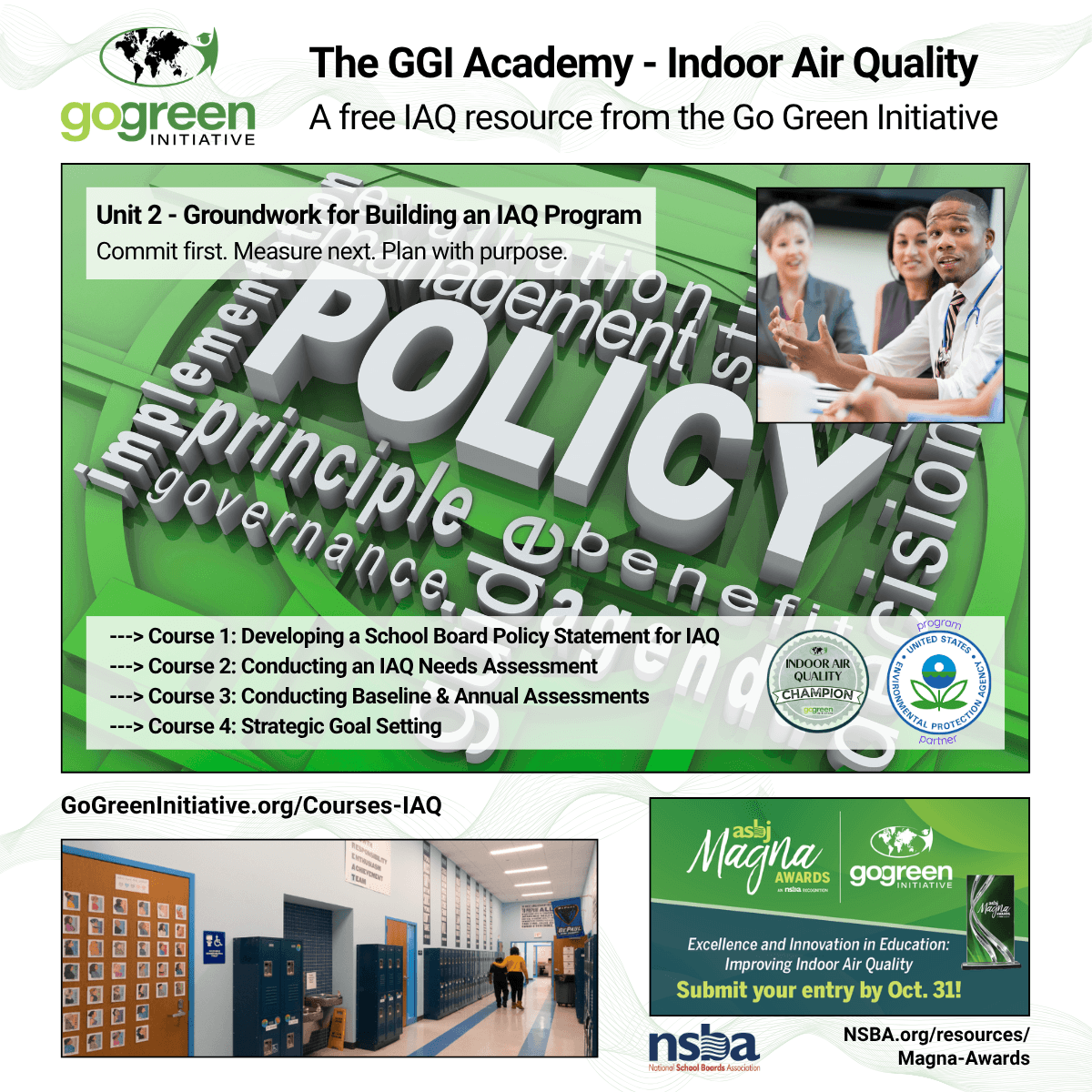
Unit 2, “Groundwork for Building an IAQ Program,” turns that vision into an actual program with four courses:
- Course 1: Developing a School Board Policy Statement for IAQ
- Course 2: Conducting an IAQ Needs Assessment
- Course 3: Conducting Baseline & Annual Assessments
- Course 4: Strategic Goal Setting
Together, they answer a different question than Unit 1 did. Unit 1 asked, “What should our program look like?” Unit 2 asks, “How do we make it real, and make it last?“
The Sequence Mirrors EPA’s Own Framework
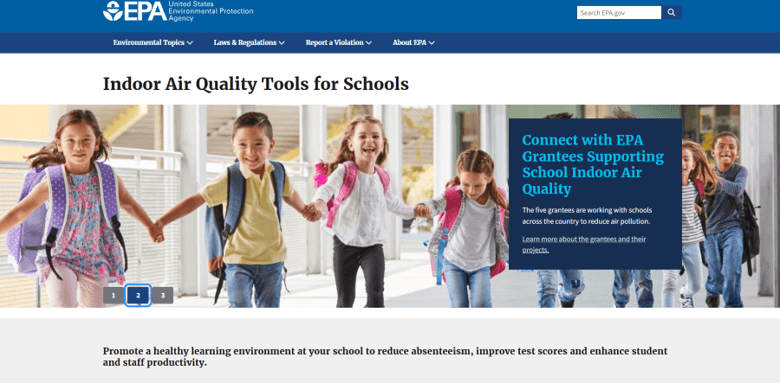
This isn’t GGI’s invention. The EPA’s IAQ Tools for Schools Framework identifies six “Key Drivers” behind every durable school IAQ program: Organize, Communicate, Assess, Plan, Act, and Evaluate. Unit 2 walks districts through the first three in order, and for good reason: EPA’s guidance is explicit that organizing for success means securing senior buy-in and designating real authority before the assessment and planning work begins, not after.
That’s exactly what Course 1 does.

Course 1: The Board Policy That Makes Everything Else Stick
Lessons: Drafting an IAQ Policy Statement, School Board Adoption of the IAQ Policy Statement
A school board policy is the difference between an IAQ program and an IAQ initiative. A policy survives a change in superintendent. It survives a new board majority; gives your IAQ Coordinator standing to request budget; requires vendor compliance; and holds facilities staff accountable. This is because the requirement didn’t come from one person’s preference. It came from a vote.
For districts prioritizing equity, the stakes are higher. In schools where 50% or more of students receive free or reduced-price lunch, and in Native American schools operating with historically underfunded facilities budgets, IAQ improvements are often the first thing cut when priorities compete for the same limited dollars. A formal board policy doesn’t guarantee funding. However, it does make IAQ a stated institutional commitment rather than a discretionary line item that’s easy to defer.
Districts that aren’t sure where to start don’t have to write from a blank page. GGI’s National IAQ Policy Database offers ready-to-adapt policy language from districts across the country.

Courses 2 & 3: From a Snapshot to a Trend Line
- Course 2 lessons: Understanding & Preparing for an IAQ Needs Assessment, Conducting an IAQ Needs Assessment
- Course 3 lessons: Baseline Assessments (Purpose, Process & People), IAQ Building Walkthrough Assessment, IAQ Monitors, Energy Consumption and GHG Emissions, Analysis & Reflection, plus a training module for norming Building Assessment Leads across multiple sites
With policy in place, the next question is factual: where does the district actually stand? That’s what a Needs Assessment answers. It’s a one-time diagnostic covering ventilation performance, filtration, pollutant levels, moisture risk, and occupant comfort, the same categories EPA identifies as core to a healthy building.
Course 3 turns that single snapshot into an ongoing system. Baseline & Annual Assessments establish the repeatable version: a structured building walkthrough, consistent use of IAQ monitors, and a direct link back to the energy and GHG data districts started tracking in Unit 1. For districts with more than one campus, the norming training in this course matters as much as the assessment tools themselves. It’s what keeps two different assessment leads from scoring the same hallway differently.
The distinction matters. A needs assessment tells you where you stand today. Baseline and annual assessments tell you whether you’re actually improving. This is the only way to prove a program is working.
Course 4: Where the Data Becomes a Plan
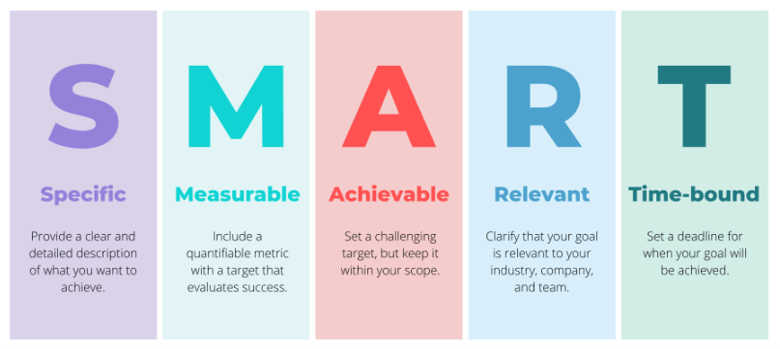
Lessons: Strategic Goal Setting Intro, Analyze Baseline Assessment Data, Identify Key Focus Areas & Develop Strategies, Set SMART Goals & Key Performance Indicators, Develop an Action Plan
This is the course we haven’t covered in depth yet, and it’s arguably where the first three courses pay off. A district can adopt a policy, run an assessment, and establish a baseline. They may still stall out if that data never turns into a decision. Course 4 closes that gap. It walks IAQ Coordinators and their teams through prioritizing focus areas, setting SMART goals with measurable KPIs, and building an action plan the district can actually execute and report against.
That last part closes the loop back to Course 1. A board that adopted an IAQ policy will eventually ask what it bought. Course 4 is what gives district leaders a real answer, in numbers, not a status update.

Why the Order Isn’t Arbitrary
Skip a step and the whole sequence gets shakier:
- Assess without policy, and the data has no institutional home. It sits in a report nobody’s obligated to act on.
- Set goals without a baseline, and you’re prioritizing by instinct instead of evidence.
- Adopt a policy without follow-through, and it becomes a document on a shelf, technically true but functionally meaningless.
Unit 2, taken as a whole, is less a checklist than a sequence built to reinforce itself: authority, then evidence, then a plan the district is accountable for delivering.

Take the Next Step
All four Unit 2 courses are free and on-demand through the GGI Academy IAQ Courses library, alongside GGI’s ongoing IAQ in Schools webinar series for districts who want live Q&A support as they work through each stage. Completing a course also earns points toward your district’s 2027 Magna Award application, but that’s a bonus, not the point. The real return is a program that outlasts whoever’s running it this year.
Commit first. Measure next. Plan with purpose.
The Go Green Initiative – Healthier air, healthier schools, and healthier futures. Learn more at:
GoGreenInitiative.org/IAQ | IAQ@GoGreenInitiative.org
Upload IAQ Management Plan | EPA’s IAQ Tools for Schools & ENERGY STAR® Webinars