June 17, 2026 | In Air Quality, Energy, Podcasts, Sustainability
A Smarter Way to Fight for Cleaner Air in Schools
GGI’s New IAQ Resource Hub Is Here!
Every school day, millions of children walk into buildings where the air they breathe may be working against them. The culprits are familiar: dust, mold spores, chemical off-gassing, inadequate ventilation. These aren’t abstract environmental concerns. They are daily realities in schools across the country, and they carry real consequences: increased asthma attacks, more sick days, difficulty concentrating, and learning environments that undermine the very outcomes districts are working so hard to achieve.
School and district leaders know this. So do facilities managers, IAQ coordinators, school board members, and the parents sitting in those back-to-school nights wondering why their child keeps coming home with a headache. What has often been missing isn’t awareness — it’s a clear, consolidated path to action.
That’s exactly what Go Green Initiative has built.
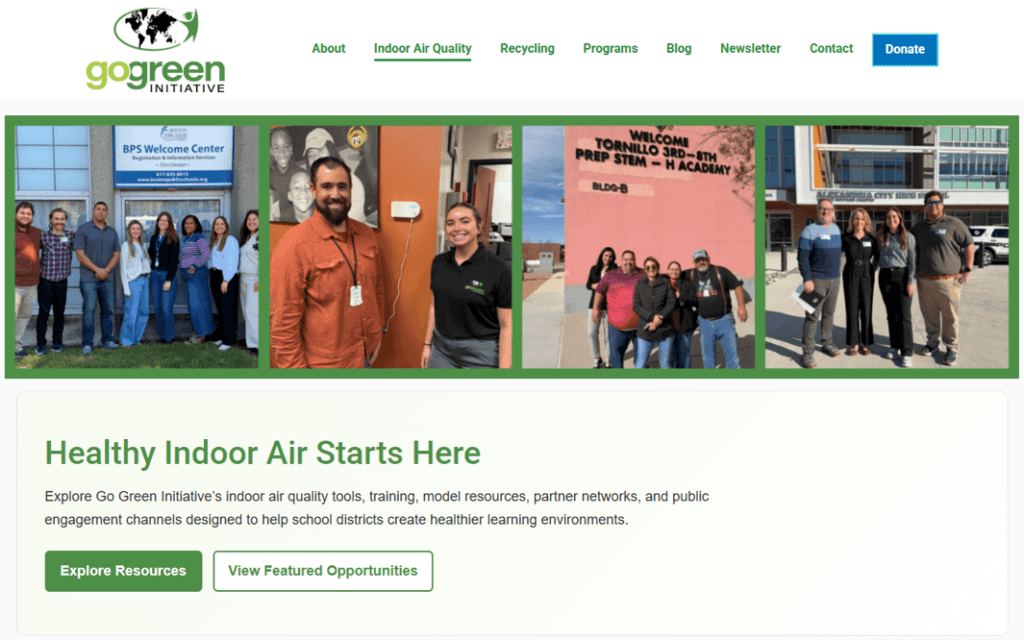
GGI’s newly expanded Indoor Air Quality resource hub, now live at GoGreenInitiative.org/IAQ, is the most comprehensive school IAQ resource platform we’ve ever offered. It brings together free courses, national best-practice databases, model policies, cohort district examples, partner networks, and major upcoming funding and recognition opportunities in one place, purpose-built for the people responsible for making schools healthier.
Why Indoor Air Quality Demands Your Attention Right Now

The evidence on poor indoor air quality in schools is unambiguous. According to the EPA, approximately one in thirteen school-age children has asthma, making it the leading chronic condition affecting school attendance in the U.S. Poor ventilation and indoor pollutants are significant triggers. The EPA also estimates that Americans spend roughly 90% of their time indoors, where concentrations of some pollutants can be two to five times higher than typical outdoor levels.
For school districts, the implications go beyond health. Studies consistently link better indoor air quality to improved attendance, reduced nurse visits, and stronger academic performance. When students aren’t missing days due to respiratory illness — and when teachers aren’t working through headaches and fatigue — everyone benefits.
And now, with the intersection of IAQ and greenhouse gas emissions emerging as a formal priority for federal recognition programs, the stakes for district leadership have grown even higher. Districts that act now are not just protecting students. They are positioning themselves for awards, funding, and national visibility.
What’s Inside the New IAQ Hub
The expanded hub is organized for practical, progressive use; whether a district is just beginning its IAQ journey or is already mid-implementation and looking to go deeper, there’s a clear entry point.
A Full IAQ Course Curriculum — Free, On-Demand
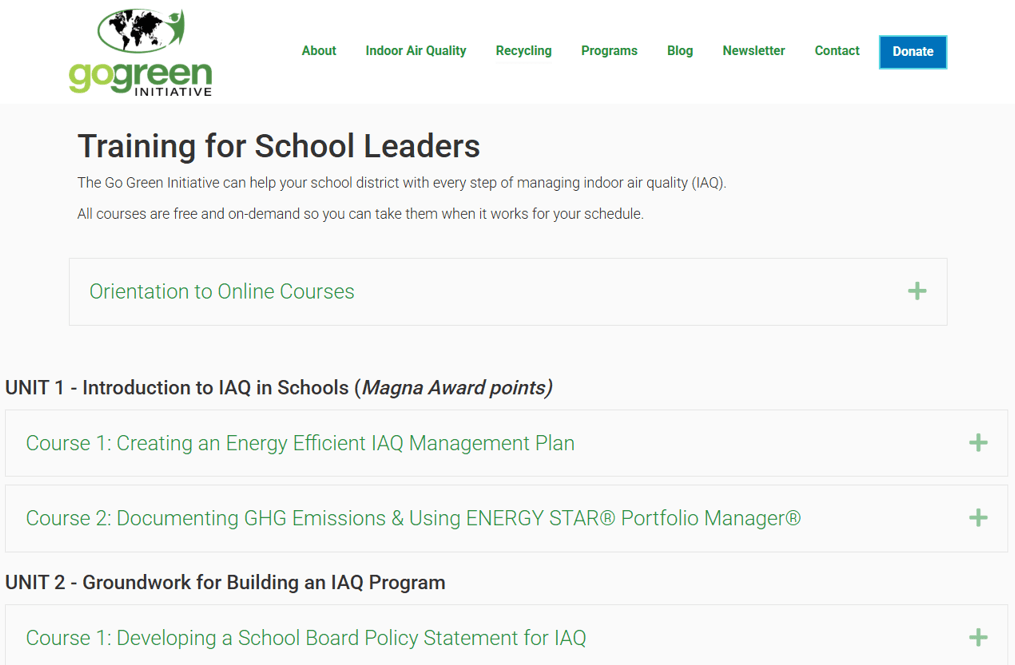
GGI’s on-demand IAQ course library is one of the most valuable free resources available to school districts today. The courses are structured in a logical learning sequence across four completed units, with two more arriving in Fall 2026.
- Unit 1 covers the essentials: creating an energy-efficient IAQ Management Plan and documenting greenhouse gas emissions using ENERGY STAR® Portfolio Manager®.
- Unit 2 builds the groundwork for a lasting program, covering school board policy development, needs assessments, baseline and annual assessments, and strategic goal setting.
- Unit 3 goes deep on specific IAQ challenges: writing the management plan, addressing mold, moisture, and temperature issues, understanding air contaminants, and managing cleaning chemicals in school environments.
- Unit 4 addresses community engagement and communications, a critical and often underestimated component of any successful IAQ program.
- Units 5 and 6, covering staff training and progress monitoring, are in development and expected this fall.
These courses are designed for the full range of district stakeholders: board members, superintendents, facilities and operations teams, and IAQ coordinators. No prior technical expertise is required to get started.
National Databases of IAQ Best Practices
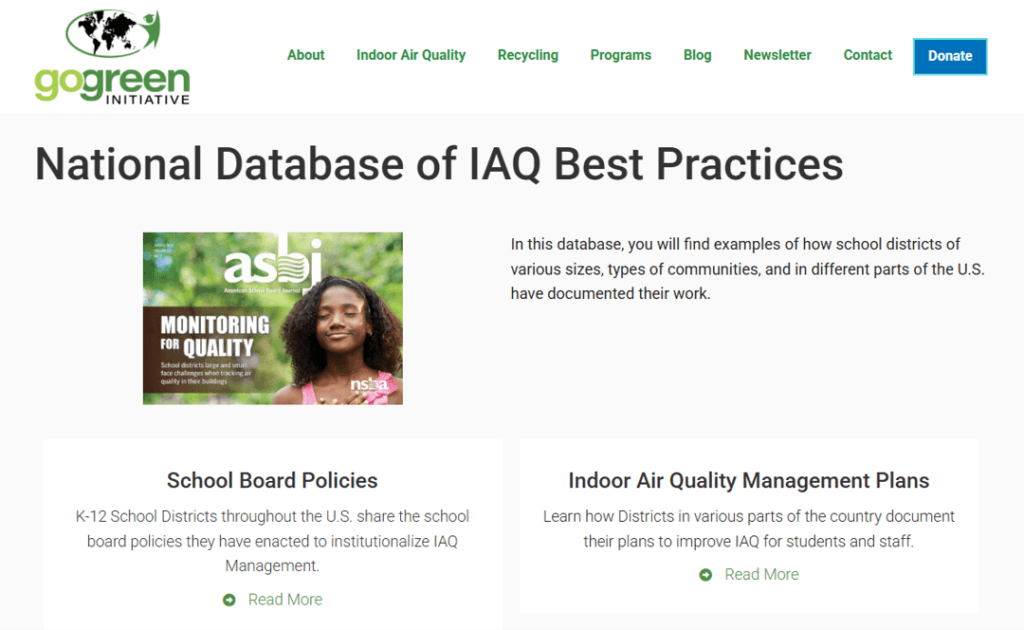
One of the most powerful ways a district can accelerate its IAQ work is by learning from peers. The hub’s National Database of IAQ Best Practices provides a growing library of real examples from school districts across the country, including model school board policies that institutionalize IAQ management and IAQ Management Plans that document how districts are organizing their work in practice.
For district leaders who have faced the challenge of building internal buy-in or drafting new policies from scratch, these examples are invaluable. Seeing what neighboring or comparable districts have accomplished — and having access to the actual documents they’ve produced — dramatically lowers the barrier to action.
Cohort District Pages
GGI’s EPA-funded cohort program has brought together school districts committed to structured IAQ implementation. The hub now features dedicated pages for Cohort 1 and Cohort 2 districts, giving visitors a window into real-world progress: what participating districts are doing, what they’ve documented, and how their work is evolving. Additional cohort pages will be added as new groups are launched.
A Trusted Partner Network
IAQ is not a problem any district has to solve alone. The hub connects visitors to GGI’s national partner organizations, including the National School Boards Association (NSBA), the National Rural Education Association (NREA), the National Indian Education Association (NIEA), the Center for Green Schools, and the American Lung Association. These partnerships reflect GGI’s commitment to reaching every kind of district, in every geography, including the rural and Tribal school communities that have historically been underserved by IAQ resources and funding.
Podcasts, Articles, and Ongoing Updates
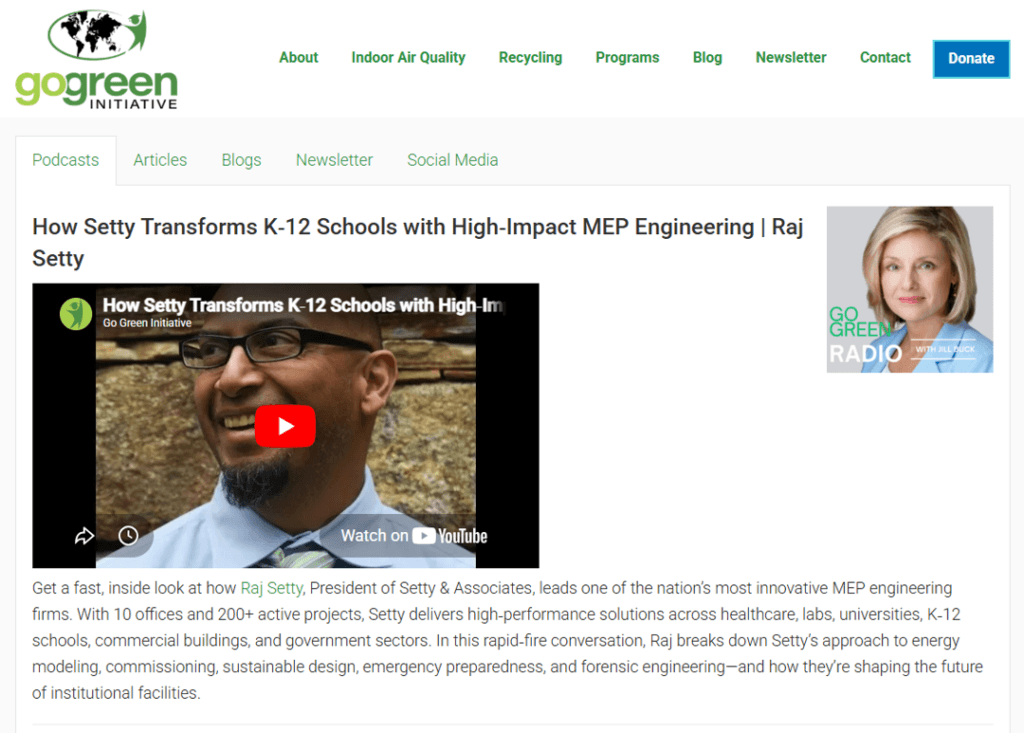
The hub also connects to GGI’s growing library of IAQ media content, including podcasts covering topics from IAQ monitoring to extreme heat and respiratory illness prevention, and articles published in outlets including the American School Board Journal. A newsletter subscription option keeps districts informed as new resources, webinars, and opportunities are added.
Two Opportunities No District Should Miss
The 2027 NSBA Magna Awards
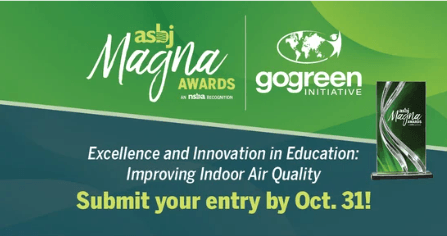
The 2027 Magna Awards program, administered by the National School Boards Association, has a focus that makes it especially timely: improving indoor air quality and reducing greenhouse gas emissions. Districts that take action now can compete for national recognition; the resources on GGI’s new hub are designed specifically to help them do it.
The nomination window opens May 15, 2026 and closes October 31, 2026. Districts can earn up to 500 points through a combination of actions:
- Submitting a new IAQ Management Plan (up to 100 points)
- Documenting GHG emissions (up to 50 points)
- Attending in-person training at the 2026 CUBE breakout session with GGI (100 points)
- Completing webinars (up to 120 points) and online courses (up to 130 points)
Grand prize and silver award winners will be recognized across urban, rural, and suburban categories, with grand prize winners presenting at NSBA’s 2027 Annual Conference and featured in the American School Board Journal.
This is a rare opportunity for districts to be recognized nationally for work that directly benefits students and staff. The path to eligibility runs directly through GGI’s free courses and planning tools.
A New Funding Opportunity — Coming Soon

A significant new funding opportunity is in development and will be available to school districts to support hands-on IAQ improvements. Key details include up to $40,000 in estimated total support per district, no matching funds required, IAQ monitoring equipment, and step-by-step technical assistance through implementation. Priority will be given to economically distressed and Tribal school districts, communities that often carry the greatest environmental health burden and have had the least access to dedicated support.
Districts can sign up now at GoGreenInitiative.org/Newsletter to be notified the moment applications open.
A Resource Built for Everyone at the Table

The new IAQ hub was designed with a wide audience in mind; improving air quality in schools requires action at every level.
For superintendents and school board members, the hub offers the policy frameworks, national precedents, and structured planning tools needed to move IAQ from a facilities issue to a district-wide priority; it also provides the evidence base to make the case to the community that this investment matters.
For facilities directors and IAQ coordinators, it offers practical, technical depth: assessment protocols, management plan examples, contaminant-specific guidance, and a curriculum that builds real competency without requiring outside consultants.
For parents and community members, it represents a commitment that the adults responsible for school buildings are taking the air their children breathe seriously — and that there are real resources and real accountability structures behind that commitment.
For vendors, suppliers, and organizations working in the IAQ and sustainability space, the hub’s partner network and cohort model offer a clear picture of where school districts are in their implementation journeys; that visibility is exactly where collaboration can accelerate progress.

Start Here
The work of improving indoor air quality in schools is urgent, achievable, and more supported than it has ever been. GGI’s new IAQ resource hub puts everything a district needs in one place: knowledge, models, networks, and opportunity.
Visit the hub at GoGreenInitiative.org/IAQ to explore courses, review national best practices, and stay connected as new resources and funding opportunities become available.
Healthy air in every school isn’t just an aspiration. With the right tools and the right partners, it’s a plan.
Go Green Initiative is a national nonprofit working to improve indoor air quality and reduce greenhouse gas emissions in K-12 schools across the United States, with a priority focus on under-resourced and Tribal school communities. GGI is currently implementing an $8 million EPA grant in support of this mission. Learn more at GoGreenInitiative.org.